Understanding Risk: Lessons from HMICFRS Inspections
A review of all 44 HMICFRS inspection reports to explore what distinguishes stronger and weaker outcomes in understanding the risk of fire and other emergencies.
6/25/20268 min read


What can we learn from HMICFRS inspections?
Each HMICFRS inspection report provides a detailed assessment of an individual Fire and Rescue Service. Taken together, the reports from all services in the 2023–25 inspection round offer a valuable opportunity to look beyond individual outcomes and identify wider themes.
I was therefore interested to see what can we learn from looking across all 44 reports for a specific topic, rather than reading them one at a time.
To explore this, I reviewed the findings for the inspection area "Understanding the Risk of Fire and Other Emergencies" and checked for recurring themes. What do services graded Good or Outstanding tend to do well? Where do services receiving lower gradings tend to struggle? And what appears to differentiate stronger outcomes from weaker ones?
This article is not intended to be a critique of individual services or the inspections. Rather, it is an attempt to draw together sector-wide learning and identify some of the characteristics that appear to support stronger outcomes.
While HMICFRS has now begun publishing findings from the 2025–27 inspection cycle, many of the themes identified here remain highly relevant and provide useful insight into how services understand, communicate and use risk.
Introduction
This inspection area focuses on whether an FRS can demonstrate a clear, evidence-led understanding of the risk of fire and other emergencies in its area, and how that understanding informs decisions across Prevention, Protection, and Response.
In practice, this is arguably the most fundamental area assessed by HMICFRS. A Service’s understanding of risk underpins its CRMP, shapes how limited resources are prioritised, and provides the rationale for difficult decisions about what to focus on and what to do less of. From my experience working with FRSs across the UK, this is also an area where capability varies widely. This is not because of a lack of data or effort, but because of differences in how risk information is interpreted, communicated, and used.
Current Inspection Picture
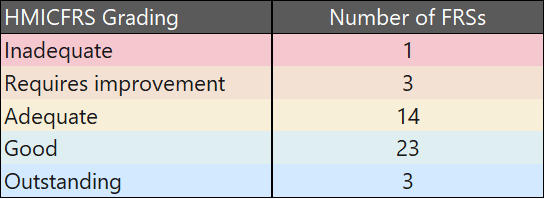
The Round 3 inspection results show that this is an area of relative strength across the sector. A clear majority of FRSs are graded Good or Outstanding, with only a small number assessed as Requires Improvement or Inadequate.
That context is important. It means there is already a strong baseline across English FRSs. However, inspection evidence also shows that there are clear differences between services that are Adequate and those that are Good. It is those differentiating features that are most informative.
What Good Looks Like in Practice
Inspection evidence from Round 3 indicates that FRSs graded Good (and the small number graded Outstanding) tend to demonstrate a consistent set of behaviours and capabilities when it comes to understanding risk. These are less about technical sophistication and more about how risk information is owned, communicated, and used.
Risk is Used to Drive Prioritisation, Not Just Described
Stronger performing FRSs are able to explain clearly and confidently:
What their most significant risks are
Why those risks have been prioritised
How this has influenced real decisions
Inspectors respond positively where leaders can articulate trade-offs, including where certain risks or activities have been deprioritised in order to focus on others. This signals that risk information is being used as a decision-making tool rather than treated as a static description of the service area.
In practice, this shows that risk profiles are being used to help the FRS decide what to focus on. Services that perform well are clear about how risk has shaped their decisions and are comfortable explaining why.
In some Outstanding-graded FRSs, including Kent and Lancashire, inspectors explicitly highlight the clarity with which senior leaders link their understanding of risk to strategic choices about Prevention focus, Protection activity, and Response arrangements.
Data is Combined Intelligently, with a Clear Understanding of its Limits
Services with stronger outcomes tend to bring together multiple datasets to build their understanding of risk. Historic incident data remains a central component (and rightly so) but it is supplemented by demographic data, vulnerability indicators, building information, and awareness of emerging risks.
What differentiates better practice is not the complexity of the model, but the FRS’s ability to explain:
Which data sources matter most for different decisions
How risk is understood at different spatial scales (local, service-wide, national)
Where data quality or coverage is limited
Inspection commentary often reflects positively where FRSs are open about uncertainty and avoid overstating what the data can tell them. This honesty appears to strengthen, rather than weaken, confidence in the FRS’s understanding of risk.
Risk Understanding is Shared Beyond Analysts
A recurring feature of stronger inspection outcomes is that risk understanding is not confined to Analysts or Strategy teams. In FRSs graded more positively:
Senior leaders can explain the logic behind the risk profile
Managers understand how it relates to their areas of responsibility
Frontline staff can articulate why certain activities are prioritised
This is where communication becomes critical. Many FRSs have very capable Analysts, but those that perform best ensure that analysis is translated into a shared organisational understanding. Risk is discussed, challenged, and interpreted, rather than simply reported.
Inspectors have highlighted this particularly strongly in some Outstanding FRSs, including Humberside, noting consistent understanding of risk across different levels of the organisation and clear alignment between analytical insight and leadership decision-making.
Risk Informs Prevention, Protection, and Response in a Joined-Up Way
Services that perform well are typically able to demonstrate a clear line of sight between their understanding of risk and how they:
Target prevention activity
Prioritise protection inspections
Design response arrangements
Inspection reports emphasise coherence across these functions rather than excellence in any single area. Risk is not treated as a standalone product; it acts as a unifying thread that informs how the FRS operates as a whole.
This reflects the intent of Community Risk Management Planning and is a strong indicator of organisational maturity.
Where Services Tend to Struggle (and Why)
Services graded Requires Improvement or Inadequate often demonstrate commitment and effort, but encounter a set of common challenges. These tend to reflect organisational issues rather than a lack of analytical capability.
Risk Products Exist, but their Purpose is Unclear
A frequent inspection finding is the presence of detailed risk profiles with limited evidence that they influence decision-making. Inspectors often highlight:
Weak links between risk analysis and resourcing decisions
Difficulty explaining how risk information has changed priorities
Documents that appear to exist largely for assurance purposes
This suggests a compliance-driven approach, where producing the risk product becomes an end in itself.
Over-Reliance on Historic Incident Data
While historic incident data is an essential component of risk understanding, inspection evidence shows that reliance on it alone can limit an FRS’s ability to anticipate future risk. This is particularly evident where:
Demographic change or vulnerability is not well reflected
Emerging risks are under-considered
Local incident volumes are too small to provide a reliable signal
In practice, the issue is rarely the use of historic data, but the absence of sufficient context around it.
Weak Connection Between Analysis and Decisions
Another common issue is a disconnect between those analysing data and those making strategic decisions. Many FRSs have capable Analysts, but inspection outcomes suggest that analysis does not always land effectively with senior leaders.
This can result in good analytical work that is not clearly reflected in priorities or activity. Where this gap exists, FRSs struggle to demonstrate grip, intent, and coherence during inspection. There are also examples of FRSs where analysis appears to be accepted without sufficient challenge, which can lead to decisions being made on insufficient or inaccurate data.
Fragmented Understanding Across the Organisation
Inspectors sometimes describe FRSs where Prevention, Protection, and Response each appear to be functioning reasonably well, but without a clearly shared understanding of risk.
In these cases, activity can look sensible in isolation, but the absence of a common narrative weakens the FRS’s overall position. This typically reflects a lack of integration rather than a lack of effort.
Summary of Findings
Across England, most FRSs are assessed by HMICFRS as either Adequate or Good at understanding the risk of fire and other emergencies. Inspection evidence shows that Services performing well in this area typically have a structured CRMP process, draw on a broad range of data and intelligence, and can demonstrate how risk information informs planning and priorities.
HMICFRS findings consistently highlight common features of stronger performance, including effective partnership working, meaningful community engagement, and the routine sharing of risk information across prevention, protection, and response functions. Services assessed more positively are generally able to show that risk is understood at multiple levels and kept under review through a combination of data analysis, operational learning, and consideration of future risks.
Where FRSs tend to receive lower gradings, inspection evidence points less to the absence of data and more to weaknesses in application. These include over-reliance on historic incident information, limited forward-looking analysis, and difficulties translating strategic risk understanding into operational or tactical use. In some cases, risk is well understood analytically but is not consistently used to inform decisions across the organisation.
Reflections on the National Picture
Perhaps the most striking finding from reviewing all 44 inspection reports is that outcomes are rarely determined by the quality of data alone. Most FRSs have access to broadly similar datasets, analytical tools and national guidance. The differences between stronger and weaker outcomes are more often found in how risk information is interpreted, communicated and used to support decision-making.
What Differentiates Outcomes
Bringing inspection evidence together with professional experience, stronger outcomes are consistently associated with a small number of underlying capabilities:
The FRS can explain how its understanding of risk has driven real prioritisation decisions
Risk assessments draw on multiple datasets and spatial scales
Analysis is interpreted and communicated effectively across the organisation
Risk understanding informs Prevention, Protection, and Response coherently
The FRS takes a forward-looking view of risk
The approach to understanding risk is open to challenge and peer review
These capabilities reflect organisational maturity more than technical sophistication.
My Perspective
In many cases, services should focus less on perfecting models and more on ensuring that their understanding of risk is genuinely used.
That means:
Being clear about what the risk assessment is for
Making sure analysis informs difficult choices, not just describes problems
Investing time in communication between analysts and decision-makers
Embedding risk understanding across the whole FRS, not isolating it within a single team
There is no single “right” way to model risk. A simple, well-understood approach that drives decisions will always outperform a complex model that is poorly communicated, weakly owned or lacks assurance.
Why This Matters
A clear and defensible understanding of risk underpins the credibility of a service’s CRMP, supports transparent decision-making, and provides a basis for accountability to the public.
Services that can explain how and why they have defined and prioritised risk are better placed to justify their choices, whether that’s to inspectors, Fire Authorities, or local communities. Where this capability is weak, inspection outcomes tend to reflect that. Where it is strong, it provides a solid foundation not only for inspection, but for effective and resilient service delivery.
Closing Thoughts
This review focuses on a single inspection area, but the same approach could be applied across the wider HMICFRS framework.
The inspection grading is important, but what interests me most is what the findings tell us about how Fire and Rescue Services make decisions, prioritise resources, and improve outcomes for their communities.
If you're involved in CRMP development, risk modelling, strategic planning, or preparing for inspection, I'd be interested to hear whether these themes reflect your own experience.
About This Analysis
This article is based on a review of the published HMICFRS inspection reports for all 44 Fire and Rescue Services in England from the 2023–25 inspection round (https://hmicfrs.justiceinspectorates.gov.uk/frs-assessments-year/2023-2025/), together with the published HMICFRS inspection framework (https://hmicfrs.justiceinspectorates.gov.uk/publication-html/fire-and-rescue-services-inspection-programme-and-framework-commencing-june-2025/). All source material is publicly available. The observations presented here are my own interpretation of the inspection findings and are intended to identify common themes across the sector rather than assess the performance of any individual Fire and Rescue Service.